
Mailchimp Review
The biggest name in email — coasting on reputation
Mailchimp is an overpriced product trading on name recognition. The interface is really easy to use, the integrations are impressive, and the templates look great. But you are paying a premium for the brand while getting middling deliverability, gutted free plan, terrible support below $350/month, and the industry's most controversial billing practice (charging for unsubscribed contacts). MailerLite does the same job for half the price with better deliverability. The only reason to choose Mailchimp in 2026 is if you need a specific integration that only works with Mailchimp, or if the brand recognition truly matters for your business.
Our Verdict
Mailchimp is an overpriced product trading on name recognition. The interface is really easy to use, the integrations are impressive, and the templates look great. But you are paying a premium for the brand while getting middling deliverability, gutted free plan, terrible support below $350/month, and the industry's most controversial billing practice (charging for unsubscribed contacts). MailerLite does the same job for half the price with better deliverability. The only reason to choose Mailchimp in 2026 is if you need a specific integration that only works with Mailchimp, or if the brand recognition truly matters for your business.
Best for
Complete beginners who want the easiest interface and maximum third-party integrations
Not for
Anyone with 5,000+ contacts (dramatically overpriced), ecommerce businesses (Klaviyo is far superior), or anyone who needs real customer support
Mailchimp — The Full Picture
Mailchimp is the most recognised brand in email marketing, and in 2026, that brand recognition is doing most of the heavy lifting. The interface really is easy to use -- G2 rates ease of use at 4.3/5, and for a first-time email marketer, the drag-and-drop builder has the shortest learning curve we found. The 300+ integrations are outstanding; if a SaaS product connects to an email tool, it connects to Mailchimp first. The 260+ templates on paid plans are professional and mobile-responsive.
But the post-Intuit trajectory tells a concerning story. Since the $12 billion acquisition, the free plan has been gutted from 2,000 contacts to just 250. Pricing has increased 20-30% across the board. Automations, A/B testing, and email scheduling were removed from the free plan in June 2025. The practice of charging for unsubscribed contacts -- meaning you pay for contacts who will never receive another email -- remains one of the most criticised billing practices in the industry.
The deliverability picture has deteriorated measurably. EmailDeliverabilityReport measured just 78.35% inbox placement with 20.03% going to spam. More concerning, deliverability is middling at 78.35% inbox placement (EmailDeliverabilityReport) between Q1 2024 and Q1 2025. For a platform at this price point, that trajectory is difficult to defend.
Pricing Breakdown
Mailchimp pricing has become one of the hardest to justify in email marketing, especially at scale. The Free plan (250 contacts, 500 emails/month, 250/day cap) is now effectively a demo -- no automations, no A/B testing, no scheduling. Compare this to Brevo's free plan (unlimited contacts, 300 emails/day, basic automation included) or Kit's free plan (10,000 subscribers with broadcasts and landing pages).
The Essentials plan starts at $13/month for 500 contacts, scaling to $110/month at 10,000 contacts and $270/month at 25,000. The Standard plan runs $20/month for 500 contacts up to $135/month at 10,000. Phone support only appears on Premium at $350/month for 10,000 contacts. For comparison, MailerLite charges $73/month at 10,000 contacts with comparable features and better deliverability.
The hidden costs are where Mailchimp really stings. You are charged for ALL contacts, including unsubscribed and bounced -- unless you manually archive each one. Custom domain authentication costs $137.81/year. Overage fees apply if you exceed your email or contact limits. At 10,000 contacts, Mailchimp Standard costs nearly double what MailerLite charges for equivalent features. The only pricing advantage Mailchimp has is the low entry point at $13/month, which disappears quickly as your list grows.
Check Current PricingDoes Mailchimp Reach the Inbox?
Mailchimp deliverability is middling, and the data from multiple independent sources confirms this. EmailToolTester measured 89.5% in January 2024 -- a respectable number at the time. But EmailDeliverabilityReport's ongoing testing paints a less flattering picture: 78.35% inbox placement, 20.03% going to spam, and 2.09% lost entirely. That puts Mailchimp 10th out of 24 providers tested -- below average for a premium-priced platform.
The results vary by category. Health-related emails fare best at 81.59% inbox placement, while dating and finance content drops to 75.19%. If you operate in a niche that email providers flag more aggressively, Mailchimp's shared IP infrastructure makes that worse -- your sender reputation depends partly on what other Mailchimp senders on your shared IP are doing. Dedicated IPs are available but only on the Premium plan at $350+/month, putting them out of reach for most users.
Mailchimp scored 3.0/5 for deliverability features -- the lowest among all platforms we analysed. For context, MailerLite tested at 89.8% on EmailToolTester, Brevo at 89.1%, and ActiveCampaign at 94.2% in the same January 2024 round. On EmailDeliverabilityReport, MailerLite scores 78.24% inbox -- nearly identical to Mailchimp's 78.35%. The honest read: Mailchimp deliverability is not catastrophic, but it is not good enough to justify the premium pricing. You are paying more and getting middle-of-the-pack inbox placement.
Automation & Features
Mailchimp automation has gone through a turbulent transition that left many users frustrated. The Classic Automation Builder -- which long-time users relied on -- was retired in June 2025. The replacement Customer Journey Builder is paywalled behind the Standard plan ($20+/month) and is widely regarded as a step backward in capability.
On the Essentials plan ($13/month), you get basic automations -- welcome emails, abandoned cart (with ecommerce integration), and simple drip sequences. The Standard plan adds the Customer Journey Builder with branching logic, A/B testing within automations, and send-time optimisation. But compared to ActiveCampaign's 135+ triggers and 750+ recipes, or even GetResponse's Marketer plan automation, Mailchimp's capabilities feel limited for the price.
The fundamental issue is that Mailchimp was built as a newsletter tool and automation was bolted on later. It shows. The workflow builder lacks the depth of dedicated automation platforms -- fewer trigger types, simpler conditional logic, and limited scoring or tagging capabilities. For basic email sequences (welcome, abandoned cart, birthday), Mailchimp works fine. For multi-step conditional workflows with branching paths based on behaviour, you will hit limitations quickly.
Mailchimp in Action
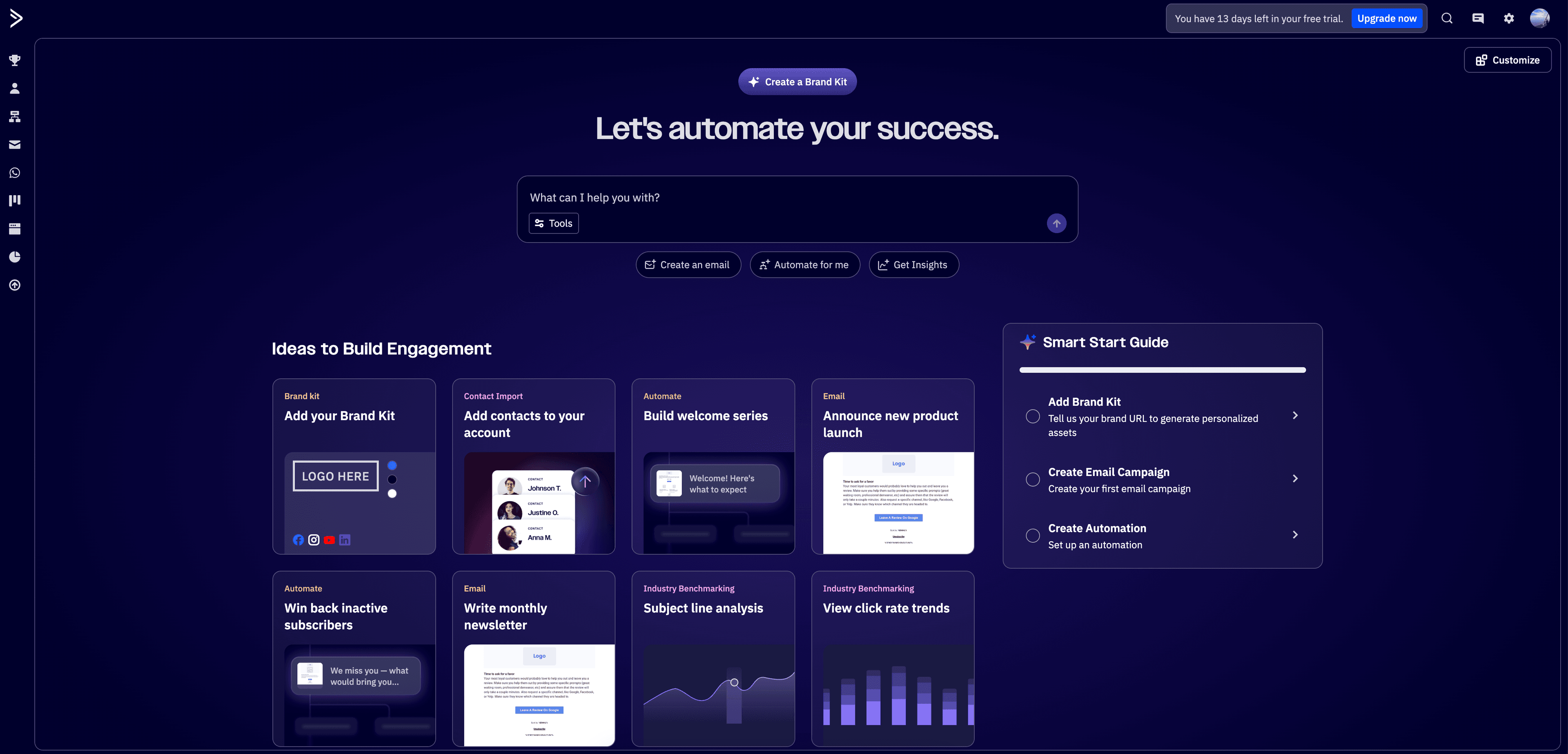
Dashboard (new UI) — Smart Start Guide with campaign creation and benchmarking tools
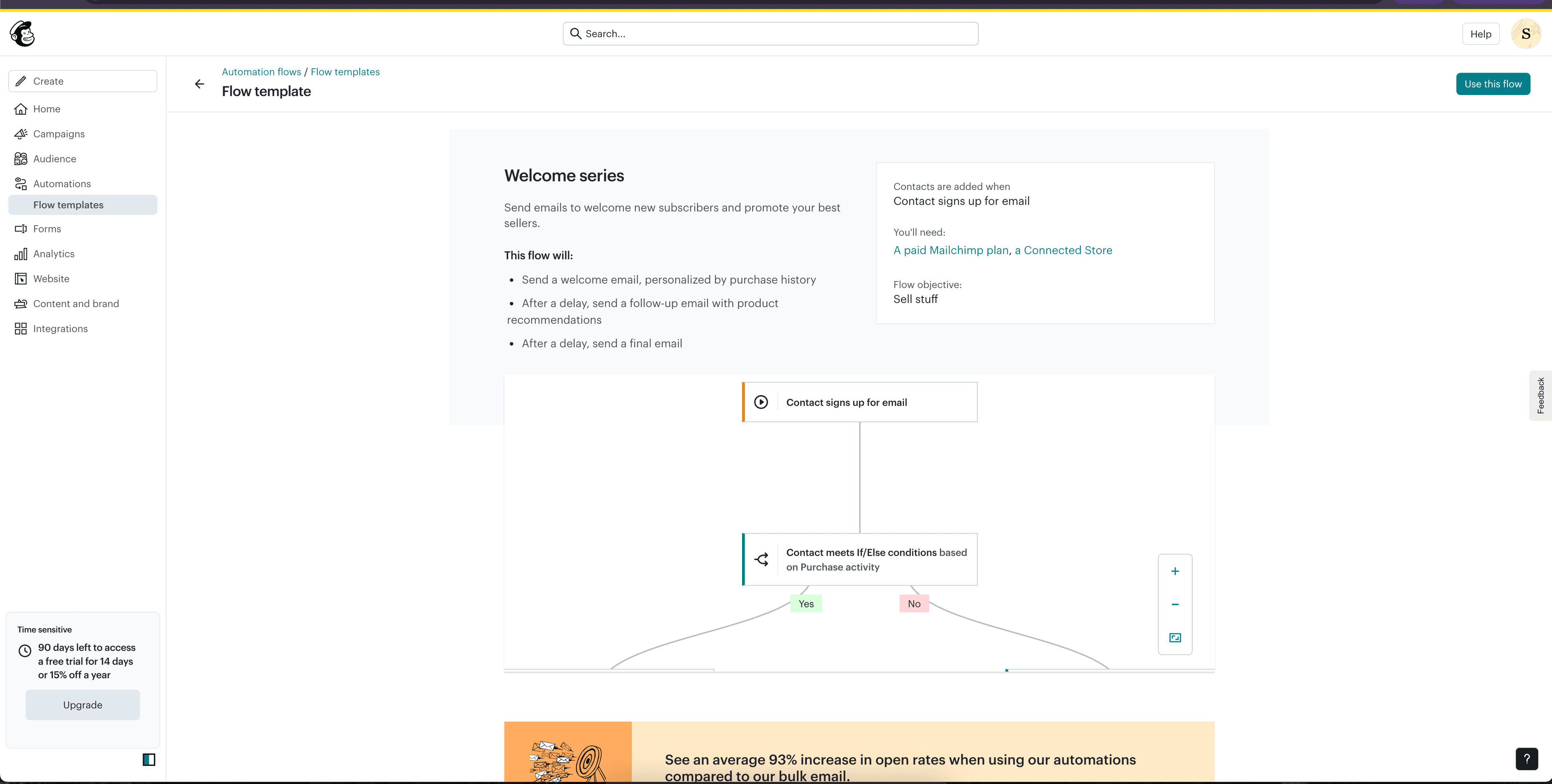
Automation — Welcome series flow template with purchase-based branching
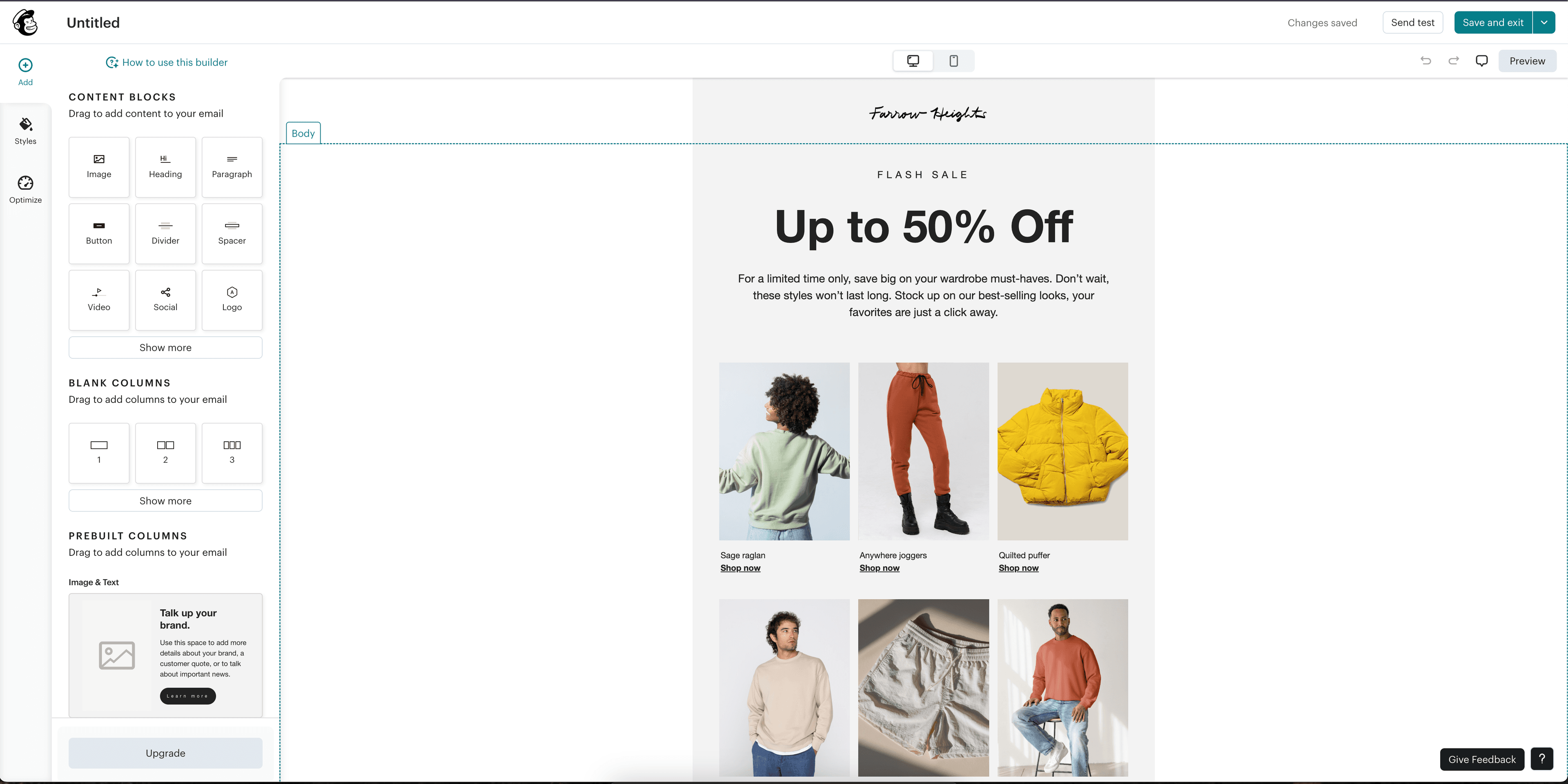
Email editor — drag-and-drop builder with content blocks and preview
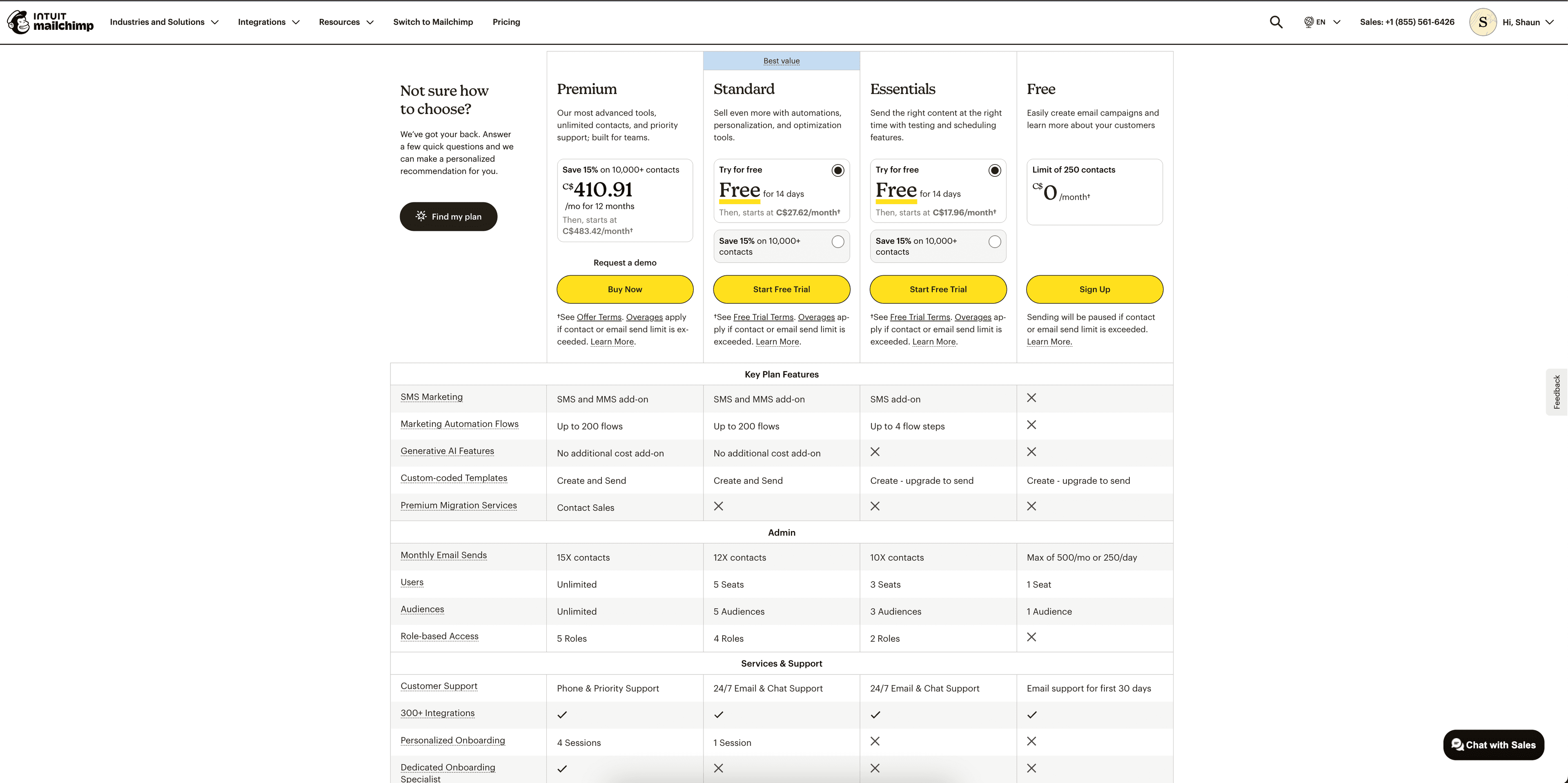
Pricing — Premium ($410/mo), Standard ($28/mo), Essentials ($18/mo), Free (250 contacts)
Detailed Scores
What We Like
- Genuinely intuitive interface — G2 rates ease of use 4.3/5, Capterra 4.4/5. The drag-and-drop builder has a shallow learning curve for basic campaigns
- 300+ third-party integrations — the largest ecosystem of any email tool. Nearly every SaaS product connects to Mailchimp natively
- 260+ professional templates on paid plans. The email builder produces clean, responsive emails that look good on mobile
- Brand recognition means clients and contacts trust seeing Mailchimp — this has real value for businesses that share their email provider publicly
- AI content tools for email copy and design are functional, though reviews are mixed on quality
- Send Time Optimization on Standard+ plans uses machine learning to deliver emails when each subscriber is most likely to engage — Mailchimp reports up to 23% higher click rates for campaigns using the feature, and it requires zero manual configuration
What Could Be Better
- Free plan has been systematically gutted: 2,000 contacts (pre-2021) → 500 (2023) → 250 (Jan 2026). Automations removed June 2025. A/B testing removed. Email scheduling removed. It is now effectively a demo, not a free plan
- Charges for ALL contacts including unsubscribed and bounced — you pay for contacts who will never receive an email unless you manually archive each one. Most competitors only bill for active subscribers
- Trustpilot: 2.7/5 with 67% one-star reviews. Support is widely despised — phone support only available on the $350+/month Premium plan. Below that, users report chatbots and generic responses
- Pricing increased 20-30% since the Intuit acquisition. At 10,000 contacts, Mailchimp Standard costs $135/month vs MailerLite at $73/month — nearly double for comparable features
- EmailDeliverabilityReport measures 78.35% inbox placement with 20.03% going to spam. Shared IP infrastructure means your sender reputation depends on other Mailchimp users
- Classic Automation Builder retired June 2025. The replacement is paywalled and widely regarded as basic compared to ActiveCampaign or Klaviyo. January 2022 security breach exposed 133 companies' data
What Real Users Say
The community sentiment around Mailchimp has shifted dramatically since the Intuit acquisition, and the review data tells the story clearly. G2 (4.3/5 from 12,500+ reviews) and Capterra (4.5/5) reflect the legacy of a once-great tool with years of positive reviews baked in. Trustpilot (2.7/5 from 1,365 reviews with 67% one-star) reflects the current reality.
The Trustpilot reviews are dominated by three themes: support that is effectively nonexistent below the $350/month Premium plan, pricing increases that caught long-time users off guard, and the unsubscribed contact billing practice. Users describe being stuck with chatbots when they need human help, receiving generic responses that do not address their specific issues, and waiting days for resolution on time-sensitive problems.
The positive sentiment that remains centres on ease of use and integrations. Users who need to connect their email marketing to a specific CRM, ecommerce platform, or analytics tool consistently note that Mailchimp integrates where others do not. The consensus across forums and review sites is increasingly clear: Mailchimp is fine if you are small and simple, but you are paying a brand tax that grows more expensive every year.
Who Should Use Mailchimp
Mailchimp makes sense for a narrower audience than its marketing suggests. The ideal Mailchimp user is a complete beginner with fewer than 500 contacts who values the easiest possible setup and has no automation needs beyond basic welcome emails. The interface is the most intuitive we reviewed, and for someone sending their first newsletter, the learning curve is the shallowest in the industry.
Businesses that depend on specific integrations are the other clear use case. With 300+ native integrations, Mailchimp connects to tools that competitors simply do not support. If your workflow requires a specific CRM-to-email connection that only Mailchimp offers, the premium is justified by the time saved on workarounds.
Brand-conscious businesses also benefit. If you operate in a space where your email provider is visible to clients -- proposals, shared campaign reports, branded templates -- the Mailchimp name carries trust. Finally, Mailchimp works for businesses that need 260+ professional templates without the time or budget to design custom emails. The template library is the largest among the platforms we reviewed.
Who Should Skip Mailchimp
Avoid Mailchimp if you have more than 5,000 contacts. The pricing becomes dramatically uncompetitive at scale -- $135/month at 10,000 contacts on Standard versus $73/month at MailerLite for comparable features. This is not a marginal difference; it is nearly double the cost for equivalent functionality with worse deliverability.
Avoid it for ecommerce. Klaviyo and Omnisend both offer deeper product integrations, better revenue attribution, and more sophisticated purchase-behaviour automation. Mailchimp's ecommerce capabilities are surface-level by comparison.
Avoid it if customer support matters to your business. Below the $350/month Premium plan, you are limited to chatbots and email support with widely reported response quality issues. If an email campaign breaks on a Friday afternoon, you need a platform that will help you fix it. MailerLite and AWeber both offer live chat at a fraction of the price.
Avoid it if deliverability is a priority. 78.35% inbox placement with 20.03% going to spam (EmailDeliverabilityReport) are not numbers that inspire confidence at this price point. MailerLite (89.8%), Brevo (89.1%), and ActiveCampaign (94.2% in EmailToolTester) all outperform Mailchimp in independent testing.
How Mailchimp Compares
The natural comparison for Mailchimp is MailerLite, because MailerLite is increasingly where former Mailchimp users end up. Both target the same audience -- small businesses and creators who want simple, visual email marketing -- but the value proposition has diverged sharply.
MailerLite costs 47-58% less than Mailchimp at comparable subscriber counts. At 2,500 subscribers, MailerLite charges $25/month versus Mailchimp Standard at $60/month. At 10,000 subscribers, the gap widens: $73/month versus $135/month. MailerLite only charges for active subscribers; Mailchimp charges for everyone including unsubscribed contacts.
Deliverability is a wash on one test (MailerLite 78.24% inbox vs Mailchimp 78.35% on EmailDeliverabilityReport) and favours MailerLite on the other (89.8% vs 89.5% on EmailToolTester January 2024). MailerLite includes automation on its free plan; Mailchimp removed automations from free in June 2025.
Where Mailchimp wins: 300+ integrations versus MailerLite's smaller ecosystem, 260+ templates versus roughly 90 on MailerLite, and brand recognition that still carries weight. But on raw value -- price, deliverability, features per dollar -- MailerLite wins decisively. Mailchimp's advantages are increasingly about polish and ecosystem, not performance.


